
Best Places to Live in Ottawa Without a Car

Living without a car in Ottawa is completely realistic, but only in the right neighbourhoods. While much of the city is designed around driving, there are specific areas where daily life works on foot, by bike, or using transit without constant friction.

This guide focuses on where car-free living actually works in Ottawa, based on access to essentials, transit reliability, walkability, and year-round practicality.

What “Car-Free” Really Means in Ottawa

Living without a car does not mean never leaving your neighbourhood. It means:

  • Groceries, pharmacies, and coffee are walkable

  • Transit is reliable enough to replace driving

  • Streets feel safe and usable in winter

  • Daily routines do not require constant planning

Neighbourhoods that support car-free living tend to be denser, older, and built around people rather than parking.

Centretown

Centretown is one of the easiest places in Ottawa to live without a car. Most residents can walk to grocery stores, medical services, gyms, cafes, and restaurants within minutes.

Transit access is strong, with multiple bus routes and proximity to the O-Train. Cycling is also practical thanks to flatter terrain and connected routes.

Because Centretown is dense and active year-round, car-free living here feels natural rather than restrictive.

Best for: people who want a fully urban, walk-everywhere lifestyle.

Hintonburg

Hintonburg supports car-free living through a combination of walkability and transit access. Wellington Street West provides most daily essentials, while nearby transit routes connect residents to downtown and other core areas.

Many people in Hintonburg rely on a mix of walking, cycling, and transit, using a car only occasionally or not at all.

The neighbourhood’s compact size makes errands efficient, and its connection to adjacent areas expands what is reachable without driving.

Best for: people who want car-free living with strong local culture and food options.

The Glebe

The Glebe works well for car-free living if daily needs are prioritized over long-distance commuting. Bank Street provides groceries, pharmacies, cafes, and services, while nearby transit routes cover most travel needs.

Many residents walk for errands and use transit for work or appointments. Access to the Rideau Canal pathways also makes cycling a viable option.

The Glebe’s layout allows most routines to stay within the neighbourhood, reducing the need for a vehicle.

Best for: people who want walkability in a quieter, residential setting.

Westboro

Westboro allows for car-light or car-free living, especially near Richmond Road and Churchill Avenue. Grocery stores, cafes, fitness studios, and services are clustered closely enough to support walking.

Transit access continues to improve, and cycling infrastructure connects Westboro to downtown and surrounding areas.

While some parts of Westboro are more spread out, living close to the commercial core makes car-free routines realistic.

Best for: people who want walkability with access to nature and a slower pace.

Sandy Hill

Sandy Hill is highly walkable and well suited to car-free living, particularly for students and professionals working downtown.

Its proximity to the University of Ottawa, Rideau Centre, and the ByWard Market means most daily needs are accessible on foot. Transit connections are frequent and reliable.

The neighbourhood’s density and grid layout make walking efficient even in winter months.

Best for: students, academics, and downtown professionals.

ByWard Market

The ByWard Market offers unmatched proximity to amenities, transit, and employment. Everything from groceries to entertainment is within walking distance.

However, car-free living here comes with tradeoffs. Foot traffic is high, noise levels are elevated, and the environment is more intense than residential neighbourhoods.

For people who value access above all else, it remains one of Ottawa’s most car-free-friendly areas.

Best for: people who prioritize location and activity over quiet.

Living Without a Car in Winter

Winter is the true test of car-free living in Ottawa. The neighbourhoods that perform best share a few traits:

  • Sidewalks that are cleared consistently

  • Short distances between essentials

  • Density that keeps streets active year-round

Areas built before car-centric planning tend to handle winter better, as they were designed for walking long before driving became dominant.

Final Thoughts

Living without a car in Ottawa is less about personal discipline and more about neighbourhood design. When daily needs are nearby and transit works as intended, car-free living becomes easier, cheaper, and often more enjoyable.

Choosing the right area removes friction from daily life and allows the city to work with you rather than against you.

Why “Third Places” Matter More Than You Think

And Where to Find Them in Ottawa

Most people think a neighbourhood is defined by its homes. The streets. The architecture. The price points.

But in real life, the places that shape how a neighbourhood feels usually aren’t homes at all.

They’re what urban planners call “third places.”

Not home.
Not work.
But the spaces in between.

Third places are where you become a regular, where faces start to look familiar, and where a city stops feeling anonymous and starts feeling like somewhere you belong.

Ottawa is quietly full of them.

What Exactly Is a “Third Place”?

The term comes from sociologist Ray Oldenburg, who described third places as informal public spaces that foster community, connection, and a sense of belonging. Think cafés, local pubs, parks, markets, gyms, libraries, and even corner stores.

They matter because they:

  • Reduce isolation

  • Strengthen neighbourhood identity

  • Make cities feel livable, not just functional

  • Help people put down roots without realizing it

In other words, third places are often the reason someone says, “I just really love living here,” even if they can’t quite explain why.

Ottawa’s Third Places, Neighbourhood by Neighbourhood

Ottawa doesn’t always get credit for its community culture, but if you know where to look, it’s everywhere.

Here are some local examples that consistently act as social anchors.

Coffee Shops That Double as Community Hubs

Places like Ugly Monday and Vylora aren’t just about coffee. They’re where:

  • Freelancers work all morning

  • Neighbours bump into each other unexpectedly

  • Conversations happen without planning them

You don’t have to know anyone when you walk in. If you go often enough, you will.

Parks That Function Like Outdoor Living Rooms

Ottawa’s green spaces aren’t just scenic, they’re social.

Dundonald Park in Centretown becomes a shared backyard in warmer months.
Brewer Park pulls together families, athletes, and dog owners who all use the space differently but together.

These parks create routines. Morning walks. Evening hangs. Weekend rituals. Over time, they build familiarity without forcing interaction.

Markets That Create Accidental Community

Few places in Ottawa do this better than ByWard Market.

It’s busy, messy, and sometimes chaotic, but it’s also one of the city’s most powerful third places. Locals, tourists, vendors, and performers all overlap in a way that rarely happens elsewhere.

It’s not polished. That’s the point.

Gyms, Studios, and Classes That Become Social Circles

Fitness spaces are some of the most underrated third places.

Studios like Elgin Street Fitness or boutique yoga and pilates spaces across the city often become social ecosystems. You start by sharing space. You end up sharing routines, conversations, and sometimes friendships.

You don’t have to be outgoing. Repetition does the work for you.
Why This Matters More Than Ever

Modern life is efficient, but it’s also isolating. Work-from-home culture, online shopping, and algorithm-driven entertainment mean it’s easier than ever to live somewhere without actually living there.

Third places push back against that.

They’re where:

  • Newcomers integrate into the city

  • Long-time residents stay connected

  • Neighbourhoods develop personality

  • People feel anchored, not just housed

And while you can’t see third places on a listing sheet, most people feel their absence immediately.

How to Find Your Own Third Place

If you’re new to Ottawa, or even if you’ve lived here for years, the fastest way to feel more connected isn’t through a big lifestyle overhaul.

It’s through repetition.

  • Go to the same café twice a week

  • Walk the same route most evenings

  • Sit in the same park regularly

  • Take a class on the same schedule

Belonging usually shows up quietly.

The Bottom Line

People don’t fall in love with cities because of square footage or street names.

They fall in love because of the places that give them rhythm, familiarity, and human connection.

Ottawa has more of those places than it gets credit for. You just have to notice them.

And once you do, the city feels very different.

What No One Tells You About Owning a Home in Ottawa (Until You’re Already In It)

What No One Tells You About Owning a Home in Ottawa (Until You’re Already In It)

Buying a home in Ottawa is exciting, emotional, and often a huge life milestone. But once the keys are in your hand and the adrenaline fades, a lot of people realize there were parts of homeownership no one really explained.

Not because agents are hiding things. But because you don’t know what questions to ask until you’re living it.

Here are the realities of owning a home in Ottawa that most people only learn after move-in day.

1. Ottawa Winters Change How You Use Your Home

Winter doesn’t just mean snow. It changes your routines, storage needs, and even how you evaluate a property.

Things that matter more here than in many other cities:

  • Entryways with space for boots, coats, and wet gear

  • Mudrooms or defined drop zones

  • Driveway length and snow storage space

  • Sun exposure for natural light during shorter days

Homes that feel perfect in July can feel very different in January. Thinking seasonally is one of the most overlooked parts of buying well in Ottawa.

2. Maintenance Is Not One Big Cost — It’s a Series of Small Ones

Most people budget for major repairs like roofs or furnaces. Fewer people think about the constant, quieter expenses:

  • Gutter cleaning

  • Snow removal or equipment

  • Lawn care and yard maintenance

  • Filters, caulking, weatherstripping, touch-ups

None of these are deal-breakers on their own. Together, they shape how much time and energy homeownership actually takes.

This is often why some buyers later realize a condo or managed property would have suited their lifestyle better — not because they couldn’t afford a house, but because they didn’t want the upkeep.

3. Your Neighbourhood Matters More Than Your Floor Plan

Inside the home, you can renovate. Outside of it, you’re committing.

In Ottawa, neighbourhood differences show up in very real ways:

  • Snow clearing speed on residential streets

  • Walkability in winter versus summer

  • Noise levels during festival season

  • Access to trails, parks, and river pathways

  • School traffic patterns on weekday mornings

Two homes with identical layouts can feel completely different depending on where they’re located. Long-term happiness usually comes down to lifestyle fit, not square footage.

4. Older Ottawa Homes Come With Charm and Quirks

Ottawa has a lot of character homes, especially in established neighbourhoods. That charm often comes with realities buyers should understand upfront:

  • Older electrical or plumbing systems

  • Uneven floors or non-standard room sizes

  • Limited closet space

  • Additions done across multiple decades

These aren’t necessarily negatives. But they require a mindset shift. Buying an older home is often about embracing character rather than expecting perfection.

5. Your Home Will Change With Your Life Faster Than You Expect

Many buyers shop for who they are today. The home you need in three to five years can look very different.

Common shifts we see:

  • Remote or hybrid work creating space needs

  • Family changes

  • Aging pets or family members

  • Desire for quieter streets or more green space

  • Downsizing responsibilities rather than upsizing rooms

The best purchases leave room for flexibility, even if the home isn’t your forever one.

6. Ownership Feels Different Than Renting — Emotionally, Not Just Financially

Once it’s yours, everything hits differently.

  • Repairs feel more personal

  • Noise matters more

  • Neighbours matter more

  • Decisions carry more weight

That sense of pride is powerful, but so is responsibility. Understanding that emotional shift ahead of time helps buyers feel confident rather than overwhelmed.

The Best Homes Fit Your Life, Not Just Your Budget

Owning a home in Ottawa isn’t just about the purchase. It’s about how the property works for your routines, your seasons, and your future.

The right home doesn’t just look good on move-in day. It supports how you actually live.

That’s the difference between buying a house and building a home.

Why Homes Don’t Sell in Ottawa (And What Most Sellers Only Realize Too Late)

Every year in Ottawa, homes come to market with high expectations and then quietly… stall.

No showings.
No offers.
Or worse, a listing expires and the seller is left wondering what went wrong.

The uncomfortable truth is that most homes that fail to sell in Ottawa don’t fail because of the market. They fail because of decisions made before the listing ever went live.

This article breaks down the most common reasons homes don’t sell in Ottawa, and what sellers often only realize once it’s too late.

The Ottawa market doesn’t reward “testing the waters”

One of the most common mistakes sellers make is treating their listing like an experiment.

They price high “just to see.”
They plan to reduce later if needed.
They assume buyers will negotiate.

In today’s Ottawa market, buyers don’t negotiate with listings they don’t believe in. They ignore them.

The first two weeks of a listing are when serious buyers are paying attention. If a home launches overpriced, it loses momentum before the seller even realizes it. By the time the price is adjusted, buyers have already decided something must be wrong.

The market rarely gives first impressions twice.

Buyers decide before they book a showing

Most sellers still believe the showing is where the sale happens.

In reality, the decision is already half-made online.

Buyers in Ottawa scroll listings the same way they scroll everything else: quickly, comparatively, and with little patience. If a home doesn’t photograph well, isn’t clearly laid out, or fails to communicate value immediately, it gets skipped.

This has nothing to do with how nice the home actually is. It has everything to do with how clearly it is presented.

A home can be objectively good and still be invisible.

Listing descriptions are quietly costing sellers money

Many Ottawa listings rely on generic descriptions that say very little:
“Spacious.”
“Great location.”
“Must be seen.”

Buyers are not looking for adjectives. They are looking for clarity.

They want to know:

  • Who the home is actually for

  • How the layout functions day to day

  • What kind of life they would live there

When listings fail to answer those questions, buyers move on to ones that do.

This is one of the most underestimated reasons homes don’t sell.

Neighbourhood misunderstanding is a deal killer

Ottawa is not one market. It is dozens of micro-markets with different buyers, expectations, and price sensitivity.

A strategy that works in one neighbourhood can fail completely in another.

Sellers often assume buyers understand the area the way locals do. They don’t. If the value of the neighbourhood isn’t clearly communicated, buyers default to caution.

Strong listings don’t just sell a house. They explain why living there makes sense.

That context matters in a city as geographically and lifestyle-diverse as Ottawa.

Overexposure can be just as damaging as underexposure

When a listing sits on the market too long, it becomes stale.

Buyers notice:

  • Multiple price changes

  • Long days on market

  • Relisting patterns

Instead of increasing interest, overexposure creates doubt. Buyers start asking why no one else wanted it. Even good homes can develop a reputation they don’t deserve.

At that point, the seller is no longer negotiating from a position of strength.

Most sellers realize this after the listing expires

Expired listings are rarely about bad luck.

They are usually the result of:

  • A weak launch strategy

  • Pricing that ignored buyer psychology

  • Marketing that failed to create urgency

  • Advice that focused on optimism instead of realism

By the time a listing expires, sellers often understand what should have been done differently. The challenge is that the market has already seen the home.

Recovering momentum requires a completely different approach.

What successful sellers do differently

Homes that sell well in Ottawa today tend to share a few characteristics:

  • They launch with a clear, intentional strategy

  • Pricing reflects current buyer behaviour, not past peaks

  • Marketing is designed to attract attention early

  • The listing tells a coherent story about the home and its location

These sellers don’t rely on hope. They rely on preparation.

The real takeaway

If your home isn’t selling, or you’re worried it won’t, the question usually isn’t “Is this a bad market?”

It’s “Was this launched properly?”

The right strategy doesn’t guarantee the highest price imaginable. But it does protect sellers from the most common and costly mistakes, the ones that quietly erode leverage.

And in a market like Ottawa, leverage is everything.

Ottawa Real Estate in 2026: What Buyers and Sellers Actually Need to Know

Ottawa’s real estate market in 2026 is defined less by extremes and more by precision. The rapid swings of previous years have settled into a market where strategy, local knowledge, and realistic expectations matter more than timing headlines or national forecasts. Buyers and sellers who understand how Ottawa truly functions are the ones making confident, successful decisions.

This is not a market that rewards guesswork. It rewards preparation.

Ottawa is a collection of micro markets, not one uniform market

One of the most common mistakes in Ottawa real estate is assuming that the city behaves as a single market. In reality, price trends, buyer demand, and resale performance vary widely by neighbourhood.

Areas like Westboro and The Glebe continue to attract buyers looking for walkability, character, and long term value, while communities such as Stittsville and Barrhaven appeal to buyers prioritizing space, newer construction, and family oriented amenities.

Understanding these differences is critical. Pricing, marketing, and negotiation strategies that work in one neighbourhood can fail completely in another.

Buyers are focused on value, not hype

In 2026, Ottawa buyers are more analytical than they have been in years. Monthly carrying costs, lifestyle fit, and resale potential are front and centre. Many buyers are taking extra time to understand:

  • True affordability based on interest rates and amortization

  • How a neighbourhood functions day to day, not just during a showing

  • Whether a home will still suit their needs five or ten years down the line

Properties that are well located and priced appropriately are still selling efficiently. The difference is that buyers are asking better questions and moving with intention rather than emotion.

Sellers are rewarded for preparation and clarity

For sellers, Ottawa’s market continues to favour homes that are thoughtfully prepared and marketed with purpose. Buyers are paying close attention to condition, layout, and how well a property has been maintained.

Homes that perform best typically share a few things in common:

  • Strong presentation that feels clean, neutral, and move in ready

  • Clear communication around updates, upgrades, and ongoing maintenance

  • Marketing that highlights both the home and the surrounding lifestyle

In a market where buyers have options, preparation is not optional. It directly impacts both price and time on market.

Lifestyle and community matter more than ever

Ottawa buyers are increasingly choosing neighbourhoods based on how they live, not just what they buy. Proximity to trails, schools, transit, and everyday amenities is driving decisions as much as square footage.

Neighbourhoods near green space such as Gatineau Park or water access around Rideau Canal continue to see steady demand, while well connected suburban communities benefit from improved infrastructure and local services.

Understanding who a neighbourhood attracts and why helps ensure properties are positioned in front of the right audience from the start.

What this means for buyers and sellers in Ottawa

In 2026, success in Ottawa real estate is less about chasing the market and more about understanding it. Buyers benefit from clarity, preparation, and local insight. Sellers benefit from realistic pricing, strong presentation, and targeted marketing.

Ottawa remains a stable, opportunity driven market for those who approach it with discipline and local expertise. Whether buying or selling, working with professionals who understand Ottawa at the neighbourhood level can make a meaningful difference in outcomes.

If you are considering a move and want advice grounded in Ottawa specific experience, local data, and practical strategy, exploring your options early is the smartest place to start.

Ottawa Real Estate in 2026: Why the “Easy” Years Are Over (And Why That’s a Good Thing)

For the past few years, real estate felt simple.

Homes sold quickly. Prices climbed. Strategy often took a back seat to momentum. But 2026 is different, and anyone paying attention can feel it.

Ottawa’s market hasn’t collapsed. It’s matured.

That shift is catching some sellers off guard, especially those still anchored to peak-pandemic expectations. But for homeowners willing to adjust their thinking, today’s market actually offers something better: clarity.

Here’s what’s truly happening in Ottawa real estate right now and why this environment rewards good decisions more than luck.

This Is a Normal Market Again

What we’re seeing in 2026 looks much closer to a pre-2020 market than anything we’ve experienced recently.

Buyers are active, but selective. Sellers still have opportunity, but only if pricing and presentation make sense. Homes aren’t selling just because they exist. They’re selling because they’re positioned properly.

This is what a healthy market looks like.

There’s movement, but not chaos. Negotiation, but not desperation. And outcomes are driven more by preparation than timing.

Pricing Has Become the Make-or-Break Factor

In today’s Ottawa market, pricing is no longer a safety net. It’s a decision that directly affects whether a home sells smoothly, slowly, or not at all.

Overpriced homes don’t just sit longer. They lose leverage.

Buyers watch price reductions closely. A listing that starts too high often ends up selling for less than it would have if it had been priced correctly from day one.

Accurate pricing today requires:

  • Recent comparable sales, not hopeful benchmarks

  • An honest assessment of condition, layout, and location

  • Understanding buyer psychology, not just market stats

The goal is to attract serious buyers early, when interest is highest.

Buyers Are Paying Attention to Details Again

When buyers have options, they scrutinize everything.

Layout functionality. Natural light. Storage. Noise. Street appeal. The difference between a home that feels “move-in ready” and one that feels like work.

This doesn’t mean every seller needs to renovate. It does mean that ignoring presentation is no longer an option.

Clean, decluttered, well-maintained homes consistently outperform similar properties that feel rushed or neglected, even when pricing is similar.

Marketing Is No Longer Passive

Posting a listing and waiting is no longer a strategy.

Strong results today come from intentional exposure:

  • Professional photography that reflects reality

  • Clear listing descriptions that explain who the home is for

  • Digital marketing that reaches buyers where they already are

The goal isn’t maximum traffic. It’s the right traffic.

Fewer showings with stronger intent beats constant foot traffic with no offers.

This Market Rewards Experience and Discipline

In fast markets, mistakes get forgiven. In balanced markets, they don’t.

This is where experienced guidance matters most. Knowing when to adjust pricing, when to hold firm, and when to change approach can be the difference between a clean sale and months of frustration.

The best outcomes right now come from sellers who:

  • Set realistic expectations early

  • Stay flexible without being reactive

  • Work with professionals who are honest about the market, not optimistic about headlines

Thinking About Selling in 2026

If you’re considering selling this year, the smartest move isn’t rushing to market. It’s understanding your position.

What would your home realistically sell for today?
What would buyers compare it against?
What strategy gives you the strongest chance of success without unnecessary stress?

That clarity comes before the sign goes up.

If you want a straightforward, data-driven conversation about your home and the Ottawa market, that’s where I start every client relationship. No pressure. Just a clear plan based on how the market actually works right now.

Ottawa Real Estate in 2026: What a More Balanced Market Really Means for Buyers and Sellers

For the first time in a while, Ottawa’s real estate market feels… normal.

Not quiet. Not booming. Not chaotic. Just more balanced.

That shift has changed how homes are buying and selling, and it has caught some people off guard. Expectations formed during the last few years do not always line up with today’s reality. Understanding what this market actually rewards is the difference between a smooth transaction and a frustrating one.

Here is what I am seeing on the ground across Ottawa right now.

A Balanced Market Does Not Mean a Weak Market

This is one of the biggest misconceptions I hear.

A balanced market means buyers have more choice and sellers have to be more precise. It does not mean demand has disappeared. It means buyers are no longer forced to make rushed decisions without context.

Well priced, well presented homes are still selling. Some very quickly. Others take longer, not because the market is broken, but because buyers are more selective.

Balance brings predictability. Predictability rewards preparation.

Pricing Has Become the Single Most Important Decision

In today’s environment, pricing is no longer something you test. It is something you get right from the start.

Buyers are informed. They are tracking comparable sales. They notice when a home is priced above similar properties that have already sold. When a listing misses the mark, it often sits long enough to lose momentum, and that momentum is hard to rebuild.

The homes that sell best tend to be priced:

  • Based on recent local sales, not historic highs

  • With a clear understanding of condition and layout trade-offs

  • To attract interest immediately rather than relying on reductions later

Correct pricing creates confidence, and confidence drives action.

Condition Is a Bigger Factor Than Square Footage

Buyers are prioritizing homes that feel easy to move into.

That does not mean fully renovated. It means clean, bright, and well maintained. In a market with options, buyers are far less willing to take on visible work unless the price reflects it clearly.

The biggest condition-related deal makers I see:

  • Fresh paint and consistent flooring

  • Kitchens and bathrooms that function well, even if not brand new

  • Lighting, natural light, and overall feel

  • A home that looks cared for rather than neglected

Small improvements often have a larger impact than major renovations.

Buyers Are Evaluating Lifestyle, Not Just Location

Location still matters, but buyers are thinking beyond neighbourhood names.

They are asking practical questions:

  • How long is the commute, really

  • What does day-to-day life on this street feel like

  • How walkable is it to schools, parks, and amenities

  • Does this home work for how we actually live

Homes that are positioned with honest neighbourhood context tend to resonate more than listings that rely on generic descriptions.

Marketing Has to Be Strategic, Not Just Polished

Professional photos are expected. They are no longer a differentiator on their own.

What makes the difference is how a property is positioned and who it is positioned for. Effective marketing connects the right buyer to the right home with a clear story, accurate visuals, and realistic expectations.

That includes:

  • Professional photography and video that reflect the home accurately

  • Clear, straightforward listing descriptions

  • Targeted online exposure where buyers are actively searching

  • Timing that aligns with current buyer behaviour

More attention is not always better. The right attention is what matters.

What This Means If You Are Buying or Selling in Ottawa

This market rewards clarity.

Sellers who understand their home’s true position avoid long days on market and unnecessary stress. Buyers who understand current conditions negotiate more effectively and make decisions with confidence.

Whether you are buying, selling, or simply planning ahead, the smartest move right now is getting an honest read on the market and your specific situation within it.

Ottawa real estate has not stalled. It has matured. And when you approach it with the right strategy, it still works very well.

Ottawa’s Real Estate Market Doesn’t Reward Guesswork Anymore

For a long time, Ottawa real estate felt predictable.

If you owned a decent home in a decent neighbourhood, you could rely on momentum to do most of the heavy lifting. Pricing didn’t need to be precise. Presentation didn’t need to be perfect. Demand filled in the gaps.

That phase is over.

What we’re seeing now is a market that rewards accuracy, discipline, and preparation. Guesswork is getting exposed quickly.

The Market Has Shifted, But Not in the Way People Think

This isn’t a weak market. It’s a selective one.

Buyers are still active, but they’re deliberate. They’re comparing more closely. They’re walking away faster. And they’re far less forgiving of misalignment between price, condition, and value.

Sellers who assume that “Ottawa always sells” are often the ones surprised when their listing stalls.

The homes that perform best right now are not the most expensive or the most renovated. They’re the most honest.

Pricing Is No Longer a Cushion

In previous years, pricing high gave sellers room to negotiate. Today, it often does the opposite.

When a home enters the market above where buyers perceive value, it doesn’t invite conversation. It limits it.

Buyers don’t submit low offers to overpriced listings as often as people assume. They wait. Or they move on entirely.

Accurate pricing creates urgency. Inaccurate pricing creates distance.

Buyers Are Paying Attention to the Details

Today’s buyers are noticing things they used to overlook.

They’re asking better questions. They’re paying attention to layout, light, storage, and long-term livability. They’re factoring in future costs more realistically.

This is especially true for:

  • Older homes with limited updates

  • Townhomes and condos where layout efficiency matters

  • Properties competing against newer inventory

A home doesn’t need to be flawless, but it does need to make sense.

Strategy Matters More Than Speed

One of the biggest mistakes sellers make right now is rushing to market without a clear plan.

Preparation is no longer optional. Neither is marketing.

The difference between a home that sells smoothly and one that drags on often comes down to decisions made before the listing goes live, not after.

That includes:

  • Understanding who the buyer actually is

  • Knowing which features matter and which don’t

  • Positioning the home clearly within its competitive set

Once a listing is live, the market response is immediate. And it’s honest.

This Is a Healthier Market, Even If It Feels Uncomfortable

Balanced markets feel harder because they remove shortcuts.

They require better advice. Better data. Better judgment.

But they also produce more stable outcomes, fewer regrets, and cleaner transactions for people who approach them with the right expectations.

Ottawa’s market right now is not punishing sellers. It’s asking them to be realistic.

And it’s rewarding buyers who take the time to understand what value actually looks like today, not what it looked like two years ago.

The people who do best in this environment aren’t guessing. They’re prepared.

And that’s exactly how real estate should work.

Ottawa Condo Market Statistics - January 2026

Every month we take a closer look and drill down the sales data of Ottawa condos from the previous month. Here are the statistics for January 2026 in the top five "downtown" areas - Centretown, Byward Market and Sandy Hill, Little Italy (which includes Lebreton Flats), Hintonburg, and Westboro. The information will be specific to apartment-style condominiums, and only what is sold through the MLS. Also important to note that DOM (Day's On Market) is calculated to include the conditional period, which in Ottawa is roughly 14 days for almost every single transaction.


Balanced Conditions Define Ottawa’s Housing Market in January 2026

Ottawa’s housing market opened 2026 in a noticeably more balanced position than what we have seen in recent years. Inventory remains higher than pandemic-era lows, giving buyers more choice and leverage, while sellers are adapting to a market that rewards accurate pricing and patience.

Across the board, benchmark prices are down year over year, with the softest conditions showing up in townhomes and apartments. Detached homes continue to demonstrate greater price stability. Overall, January’s data points to a market that is adjusting in an orderly, healthy way rather than one under stress.

As noted by Ottawa Real Estate Board, the current environment reflects realism on both sides of the transaction. Buyers are cautious but active, and sellers are adjusting expectations without sharp price swings. That balance is an important signal heading into the spring market.

Market Activity Shows Steady Demand Beneath Seasonal Slowdown

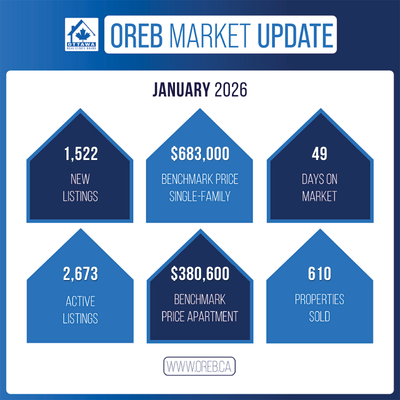
January recorded 610 residential sales in Ottawa. While this represents a typical post-holiday slowdown, activity remained within long-term January norms. Sales were 5.6 percent lower than January 2025, but demand has not disappeared. Buyers are still in the market, just more deliberate due to affordability and economic uncertainty.

Pricing followed expected winter patterns rather than signaling renewed weakness. The average residential sale price came in at $641,436, down 4.5 percent year over year. Recent interest rate reductions have started to ease pressure at the margins, but their impact is showing up first in buyer engagement rather than finalized transactions.

Benchmark pricing from the MLS Home Price Index also declined modestly month over month across all housing types. These shifts suggest seasonal cooling combined with a more price-sensitive buyer pool, not a market correction.

Inventory Levels Support a More Balanced Market

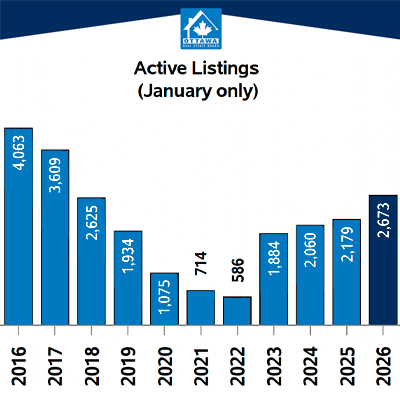
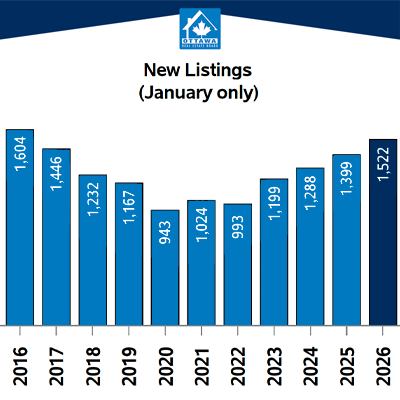
New listings totalled 1,522 units in January, an increase of 8.8 percent year over year. Active listings rose to 2,673, up 22.7 percent from last January. While inventory remains elevated compared to recent seasonal norms, the pace of growth has slowed.

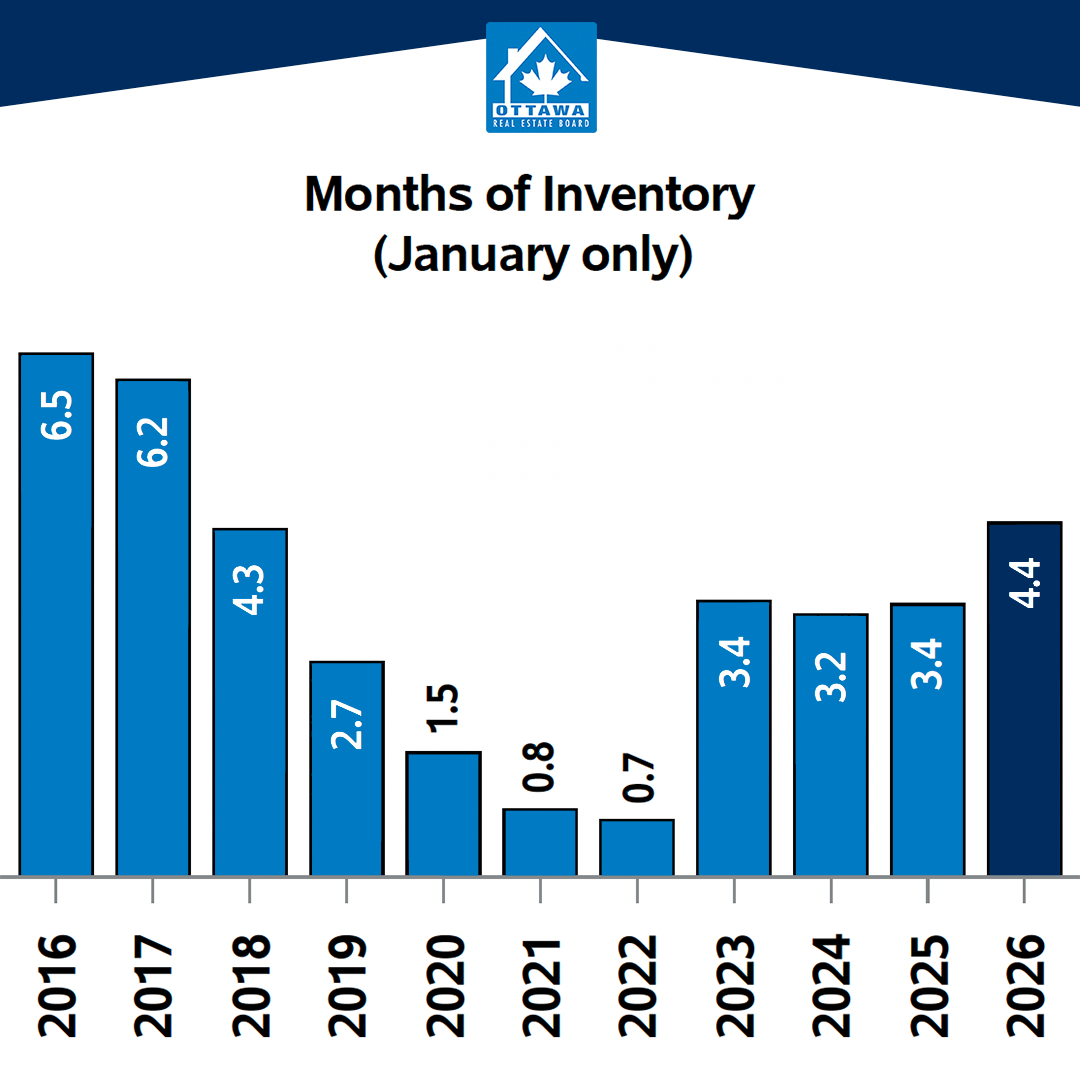
Months of inventory now sits at 4.4, which is much closer to long-term, pre-pandemic averages. This level of supply gives buyers more choice and negotiating room while still allowing well-priced homes to attract meaningful interest. Rather than pushing prices sharply downward, current inventory levels are supporting stability.

How the Market Is Performing by Property Type

Detached Homes

Detached properties remained the most stable segment in January. A total of 276 single-family homes sold, down 13.8 percent year over year. Supply remained balanced at 4.3 months of inventory, with 1,177 active listings and 663 new listings, essentially unchanged from last year.

Pricing softened slightly but held firm overall. The average sale price was $793,874, down 3.6 percent year over year. The median price remained steady at $750,000. These figures suggest detached home pricing is adjusting gradually rather than experiencing sharp declines.

Townhomes

Townhome activity showed mixed signals. Sales increased to 215 units, up 6.4 percent year over year, but new listings rose sharply to 487, a 45.8 percent increase from January 2025. Active listings climbed to 708, up 67 percent year over year.

With supply expanding faster than demand, months of inventory rose to 3.3. Pricing reflected this shift. The average townhouse sale price was $536,106, down 3.3 percent year over year, while the median price declined to $560,000. Notably, the townhouse benchmark price rose slightly month over month, suggesting some short-term stabilization.

Apartments and Condos

The apartment segment showed early signs of improvement compared to late 2025. Condo sales increased to 95 in January, up from 78 in December, while months of inventory declined to 6.8 from 7.9. This indicates stronger absorption despite higher listing activity.

New listings increased significantly to 312, and active listings rose to 647. Even with this seasonal influx of supply, improved sales activity prevented further deterioration in market balance.

Pricing remains the most sensitive in this segment. The average apartment sale price dropped to $388,307, down 12.1 percent year over year. However, the combination of rising sales and declining months of inventory suggests condo conditions may be beginning to stabilize.

Months of Inventory Snapshot

Single-family homes: 4.3
Townhomes: 3.3
Apartments: 6.8

What This Means Moving Forward

January’s data reflects a familiar winter pattern with slower sales and cautious buyers. At the same time, there are early signs that market conditions are firming, particularly in the apartment segment where absorption improved.

Detached homes continue to show resilience, townhome activity remains active despite rising supply, and condos appear to be finding a floor after a prolonged adjustment. Overall, Ottawa’s housing market is segmented by property type but remains balanced at a broader level.

This aligns with national forecasts pointing toward gradual improvement as interest rates ease and sidelined demand begins to re-enter the market. If rate reductions continue, January’s data supports a credible case for a stronger and more active spring market.

Important to note is that these statistics can only be as accurate as there are condos sold in Ottawa. The more condos sold in an area, the more accurate the averages will be.

Want to chat about your options? Fill out the form at the bottom of the page, or text/call us directly at 613-900-5700 or fill out the form at the bottom of the page.

Do you have any questions about how this information affects your investment or looking for more information to make the best decision about your purchase? Let’s chat! Fill out the form on the bottom of the page.

The Part of Buying a Home in Ottawa That Rarely Gets Talked About

Most conversations about buying a home in Ottawa focus on numbers. Price. Budget. Monthly costs. What people can or cannot afford.

Those things matter, but they are not what most people struggle with long term.

What actually shapes the experience is something quieter: how well the home supports the life someone is already living.

The “Good on Paper” Home Is Not Always the Right One

A home can check every logical box and still feel wrong once you move in.

The layout might look fine online but clash with how you move through the space. Storage might technically exist but be awkward to use. Natural light might hit at the wrong times for how you work or relax.

These issues rarely show up during a showing. They reveal themselves in daily routines.

Daily Friction Adds Up Faster Than People Expect

Small inconveniences feel manageable at first.

A tight entryway.
An awkward parking setup.
A kitchen that works, but not well.

Individually, none of these are deal breakers. Together, they quietly shape how someone feels in their home.

In Ottawa, where people spend a lot of time indoors for part of the year, these details matter more than people anticipate.

Flexibility Is Often More Valuable Than Size

Many buyers assume more space equals more comfort.

In reality, flexibility tends to matter more. Spaces that can adapt as life changes age better than ones designed for a single moment in time.

An extra room that can shift purpose. A layout that allows privacy without isolation. Storage that can grow with changing needs.

Homes that allow for change tend to feel relevant longer.

Location Shapes Energy More Than People Realize

Two homes with identical layouts can feel completely different depending on where they are.

Noise levels. Light patterns. How easy it is to step outside. How connected the home feels to the surrounding area.

These factors influence mood, routines, and even how often people leave the house. They are hard to quantify, but they are easy to feel once you live there.

The Best Decisions Are Usually Felt, Then Understood

Many buyers worry when a decision feels emotional.

In practice, emotion is often the body recognizing alignment before the mind catches up. The key is understanding why something feels right, not ignoring the feeling altogether.

The strongest decisions tend to sit at the intersection of logic and lived experience.

Buying a home in Ottawa is not just about finding something that works. It is about finding something that quietly supports the way you live, rest, and move through your days.

When that alignment is there, the decision tends to hold up long after the paperwork is done.

How People Actually Choose Neighbourhoods in Ottawa

Ask someone what they want in a neighbourhood and you’ll hear the same answers on repeat. Walkability. Schools. Transit. Space. Community.

All of that matters, but it is rarely the real reason people end up choosing one area over another.

In practice, most people choose neighbourhoods based on something much more specific: how their daily routine will feel once they live there.

Most Decisions Are Made Around One or Two Anchors

People like to believe they are comparing entire neighbourhoods. What they are usually doing is anchoring around one or two non-negotiables.

It might be:

  • A specific commute

  • A gym or studio they already love

  • A school pickup route

  • Proximity to family

  • Access to green space they use weekly

Everything else becomes secondary. Two neighbourhoods can look identical on paper, but the one that shortens a daily friction point almost always wins.

Walkability Is Personal, Not Universal

“Walkable” means very different things to different people.

For some, it means being able to walk to coffee and groceries.
For others, it means walking kids to school.
For others, it means being able to walk without crossing major roads.

This is why broad neighbourhood labels often fall flat. What matters is not whether an area is technically walkable, but whether it supports the way someone actually moves through their day.

Lifestyle Fit Matters More Than Square Footage

People rarely regret buying less space. They often regret buying the wrong location for how they live.

A larger home loses its appeal quickly if it adds stress, longer days, or logistical headaches. A smaller home in the right place tends to feel easier to live in, even if it looks less impressive online.

This is especially true in Ottawa, where neighbourhoods can feel dramatically different despite being only minutes apart.

Commute Tolerance Is Emotional, Not Logical

Two people with the same commute length can experience it completely differently.

Some people do not mind driving if the roads are predictable. Others would rather spend longer on transit if it feels calmer. Some want to avoid highways at all costs. Others avoid stop-and-go city traffic.

People often discover their true tolerance only after living with it for a while. That is why neighbourhood decisions based purely on distance can miss the mark.

Community Is Built Through Repetition

Ottawa neighbourhoods feel social not because of constant events, but because of repeated small interactions.

Seeing the same faces on walks. Going to the same café. Running into neighbours at the same park. Over time, those routines create familiarity.

People who feel disconnected in a neighbourhood are often missing a rhythm, not a personality match.

The Best Neighbourhood Is the One That Makes Life Easier

The strongest indicator that someone chose well is not excitement, but relief.

Days feel smoother. Errands feel lighter. Time feels less fragmented. Life fits.

That is rarely something you can spot from a listing description alone.

Choosing where to live in Ottawa is less about finding the “best” neighbourhood and more about finding the one that quietly supports your life as it already exists.

When that alignment is there, everything else tends to fall into place.

Why So Many People in Ottawa End Up Moving Twice (And How to Get It Right the First Time)

Many buyers and sellers in Ottawa follow a pattern they do not expect.

They purchase a home.
They settle in.
Life moves forward.
And then, a few years later, they move again.

Not because the home was wrong on paper.
Not because the market shifted dramatically.
But because the home never fully aligned with how daily life actually unfolded.

The first move is usually driven by urgency

Most first moves are shaped by pressure.

A lease ending.
A growing family.
A career change.
A separation.
A sense that it is simply “time.”

When urgency leads the decision, choices tend to focus on what is available and affordable in the moment. Those priorities are practical, but they often leave little room for reflection about long-term fit.

The home works. It just never quite feels settled.

The second move is driven by clarity

The second move tends to look very different.

By that point, people understand their habits better. They know what spaces they actually use, what they avoid, and what quietly causes friction. They understand how much walkability matters, how winter affects routines, and how commuting shapes their days.

They also understand Ottawa better.

They know which errands repeat weekly.
They know which neighbourhoods feel energizing versus draining.
They know whether driving everywhere adds stress or freedom.

That clarity often arrives only after living through compromise.

Ottawa quietly punishes “almost right” decisions

This city is full of homes that are technically fine but practically misaligned.

A townhouse that fits the budget but adds daily driving.
A condo that looks great but feels disconnected from its surroundings.
A detached home that offers space but reduces spontaneity.

In Ottawa, size alone does not guarantee quality of life. Function, location, and neighbourhood context matter more than many people expect.

When those elements are off, friction shows up slowly and consistently.

The question many buyers skip

Instead of asking “Can this work?”, a better question is:

“What will an average Tuesday look like here?”

Where will coffee come from?
How will commuting feel?
What will winter routines look like?
How will weekends naturally unfold?

Homes that support those answers tend to last. Homes that do not often become stepping stones.

How to avoid the double move

Getting it right the first time does not mean finding a perfect home. It means identifying non-negotiables early.

In Ottawa, that often comes down to three core factors:

Location that supports daily habits, not just price
A layout that reflects real living, not aspirational living
A neighbourhood that feels livable, not just convenient

When these align, people tend to stay longer, settle deeper, and build routines instead of exit plans.

Why this matters in 2026

People are more intentional with their time and energy. A home that adds friction does not just cost money. It affects daily quality of life.

Ottawa offers a wide range of lifestyles within a relatively small footprint. That flexibility is a strength, but only when decisions are made deliberately.

Final thought

Most people do not regret buying a home in Ottawa.
They regret not thinking deeply enough about how they wanted to live in it.

Approaching a move with clarity, patience, and an honest look at daily life is often the difference between a temporary solution and a long-term fit.

Why Most People Regret How They Bought Their Home (And It Has Nothing to Do With Price)

When people talk about home buying regrets, they almost always talk about money.

They say they paid too much.
They say they should have waited.
They say they wish they bought sooner or later.

But after years of watching how people actually live in the homes they buy, price is rarely the real regret.

The real regret usually shows up six months in, when daily life starts to settle.

Regret usually comes from rushing the wrong decision

Most buyers do not regret buying a home. They regret how they bought it.

They remember feeling pressure.
They remember moving faster than they were comfortable with.
They remember ignoring small concerns because everything else “felt right.”

Those small concerns tend to get louder over time.

Noise you thought you would get used to.
A layout that looked fine during a showing but feels awkward daily.
A location that works on paper but not in real life.

These things are rarely deal-breakers during a showing. They become important once the excitement fades.

People underestimate how much their lifestyle matters

Square footage is easy to measure. Lifestyle is not.

Buyers often focus on bedrooms, bathrooms, and finishes because those are visible and comparable. What gets overlooked is how the home fits into daily routines.

Commute patterns.
Where groceries actually get bought.
How often guests come over.
Whether outdoor space gets used or ignored.

A home can be objectively “good” and still feel wrong for how someone actually lives.

That disconnect is where regret starts.

The most common sentence people say after moving in

One sentence comes up more than almost any other.

“If I had known this before, I would have thought differently.”

Not because the home is bad.
Because the buyer did not slow down enough to test their assumptions.

They assumed they would cook more.
They assumed they would use the spare room.
They assumed the stairs would not matter.
They assumed they would adjust.

Sometimes they do. Sometimes they do not.

Why this happens so often

Buying a home is one of the few decisions where people are expected to move quickly, commit emotionally, and spend a large amount of money all at once.

That combination makes it easy to override instinct.

Add in outside voices, opinions, timelines, and pressure, and people often stop asking the quiet questions that matter most to them personally.

What experienced buyers do differently

Buyers who feel good about their purchase long after moving in usually share a few habits.

They are honest about how they live now, not how they hope to live later.
They test assumptions instead of ignoring them.
They accept trade-offs deliberately instead of accidentally.

Most importantly, they give themselves permission to slow down when something does not sit right, even if the home checks every box on paper.

The real goal is not the perfect home

There is no perfect home.

There is only a home that fits the version of your life you are actually living.

The buyers who end up happiest are not the ones who win the fastest or stretch the furthest. They are the ones who understand themselves well enough to recognize when something truly works for them.

Final thought

Regret in real estate rarely comes from numbers. It comes from misalignment.

When buyers take the time to understand their own habits, priorities, and non-negotiables, the decision tends to age well.

That clarity matters more than timing, trends, or headlines.

Why Some People Fall in Love With Ottawa Slowly (And Others Never Do)

Ottawa is rarely love at first sight.

For many people, the city feels fine at first. Safe. Calm. Reasonable. But not exciting. Not obvious. Not dramatic.

That is usually when the Googling starts.

People search for reassurance without realizing it. They look up neighbourhoods, lifestyles, costs, and comparisons, trying to figure out whether the feeling they have is boredom, adjustment, or a genuine mismatch.

Understanding this difference matters more than any housing decision.

Ottawa Does Not Perform for You

One of the most misunderstood things about Ottawa is that it does not try very hard to impress you.

There is no constant spectacle. No obvious centre of gravity. No pressure to participate in a specific version of city life.
For people coming from larger or louder cities, this can feel like something is missing. For others, it eventually feels like relief.

Ottawa reveals itself through routines, not highlights.

The City Rewards Repetition, Not Novelty

People who struggle in Ottawa often say there is “nothing to do.”

What they usually mean is that there is nothing new happening all the time.

Ottawa is built around repeatable pleasures:

  • The same walking routes

  • The same coffee stops

  • The same neighbourhood streets

  • The same seasonal patterns, year after year

If someone needs constant novelty to feel engaged, the city can feel flat. If someone values rhythm, predictability, and depth, Ottawa often grows on them slowly.

Social Life Here Is Quieter, But Stickier

Another common search behaviour revolves around making friends in Ottawa or feeling connected.

Social life here tends to be slower to start but more durable once it forms. People build routines around work schedules, hobbies, and neighbourhood proximity rather than spontaneous plans.

This can feel isolating at first, especially for newcomers. Over time, it often leads to smaller but more stable social circles.

People who expect instant community sometimes leave. People who allow it to build gradually often stay much longer than they planned.

Ottawa Feels Different Depending on Life Stage

Ottawa can feel like very different cities depending on where someone is in their life.

For someone in a transition phase, just out of school or unsure of direction, the city can feel too calm.

For someone building a career, a routine, or a longer-term plan, that same calm can feel grounding.

This is why people often change their opinion of Ottawa without the city itself changing at all.

Why This Matters Before Big Decisions

Many people assume dissatisfaction means they chose the wrong home or neighbourhood.

Sometimes that is true.

But just as often, the discomfort comes from expecting Ottawa to behave like a different kind of city.

People who do best here tend to adjust their expectations rather than constantly looking for what the city is not.

Staying in Ottawa Is Usually a Conscious Choice

People rarely stay in Ottawa by accident.

Those who stay long-term usually decide that they value:

  • Stability over spectacle

  • Routine over chaos

  • Familiarity over constant reinvention

Once that decision is made, the city tends to make sense.

The Question People Are Really Asking

When people Google Ottawa late at night, they are often not asking about housing at all.

They are asking:

“Will my life feel easier here or harder?”

Ottawa does not answer that question loudly. It answers it slowly, through daily experience.

The Real Cost of Living in Ottawa (That Has Nothing to Do With House Prices)

When people search “cost of living in Ottawa,” they usually expect a list of numbers.

Rent. Home prices. Taxes. Utilities.

Those matter, but they are not what most people are actually trying to understand. What they are really asking is whether life in Ottawa feels manageable, sustainable, and worth it once the novelty wears off.

This is the part that rarely gets explained clearly.

Time Is the Biggest Hidden Cost (or Benefit)

Ottawa is not cheap in the traditional sense, but it is efficient in ways people often underestimate.

Commute time is one of the biggest differences people notice after moving here. Many neighbourhoods offer a version of city life where errands, work, and downtime fit into the same day without constant rushing.

Less time spent commuting usually means:

  • More consistent routines

  • Easier weeknight plans

  • Less burnout over time

That is a real cost saving, even if it does not show up on a spreadsheet.

Daily Convenience Shapes Monthly Spending More Than You Think

People often budget for housing first and assume the rest will work itself out.

In reality, neighbourhood convenience has a direct impact on how much you spend each month.

Areas where you can walk to groceries, coffee, gyms, or parks tend to reduce impulse spending. You are less likely to rely on delivery apps, rideshares, or “just grab something quick” purchases that quietly add up.

Ottawa has many pockets where daily needs are clustered close enough to make this possible, even outside the downtown core.

Car Dependence Is a Bigger Factor Than Rent Alone

Another common search trend revolves around whether you need a car in Ottawa.

The honest answer is: it depends on where you live and how you structure your days.

Some neighbourhoods allow for a mostly walkable or bike-based lifestyle with occasional transit use. Others almost require a car, even if rent or purchase prices look similar on paper.

When comparing housing costs, people often forget to factor in:

  • Insurance

  • Parking

  • Fuel

  • Maintenance

  • Time spent driving

Those costs can easily outweigh small differences in rent or mortgage payments.

Quiet Living Changes Spending Habits

Ottawa is not a city built around constant nightlife, and that changes how people spend money socially.

Social plans tend to look like:

  • Coffee walks

  • Home dinners

  • Outdoor activities

  • Low-key neighbourhood gatherings

That rhythm naturally lowers discretionary spending for many people, especially compared to cities where social life revolves around bars, clubs, and ticketed events.

For some, this feels boring. For others, it feels sustainable.

Seasonal Living Is a Feature, Not a Flaw

Ottawa’s seasons are intense, but they create structure.

People plan differently in winter and summer, which affects spending patterns throughout the year. Summers tend to be active and outdoors-focused. Winters are quieter, more home-based, and more routine-driven.

This seasonal pacing often leads to fewer “always out” months and more balance across the year.

It is not glamorous, but it is stable.

Why This Matters Before Making Housing Decisions

People often fixate on prices without understanding the lifestyle they are buying into.

Two homes with similar price tags can lead to very different monthly experiences depending on:

  • How much time you spend commuting

  • Whether errands feel easy or exhausting

  • How often you rely on paid conveniences

Understanding those tradeoffs early leads to better long-term satisfaction, regardless of whether someone rents, buys, or waits.

Ottawa Rewards Intentional Living

Ottawa works best for people who value routines, balance, and predictability more than constant stimulation.

That does not mean it lacks personality. It means the personality reveals itself through daily life, not highlights.

For people searching quietly, trying to picture their future rather than chase a trend, this is often the deciding factor.

Ottawa Condo Market Statistics - December 2025

Every month we take a closer look and drill down the sales data of Ottawa condos from the previous month. Here are the statistics for December 2025 in the top five "downtown" areas - Centretown, Byward Market and Sandy Hill, Little Italy (which includes Lebreton Flats), Hintonburg, and Westboro. The information will be specific to apartment-style condominiums, and only what is sold through the MLS. Also important to note that DOM (Day's On Market) is calculated to include the conditional period, which in Ottawa is roughly 14 days for almost every single transaction.


Ottawa Housing Market Wrap-Up: How 2025 Ended and What It Signals Going Forward

Ottawa’s housing market closed out 2025 much the way it spent most of the year: calm, measured, and grounded in fundamentals rather than momentum or pressure.

December brought the expected seasonal slowdown. Sales eased, new listings declined, and inventory pulled back as the holidays approached. Prices, however, held steady. When the full year is viewed as a whole, the takeaway is not softness or weakness, but balance.

Despite a quieter finish, total residential sales for 2025 ended 1.3 percent higher than 2024, with total dollar volume up 4.1 percent year over year. That combination points to a market that remained functional and resilient, even as buyer behaviour became more cautious in the second half of the year.

A Year That Didn’t Follow the Usual Script

2025 did not behave like a typical Ottawa market year.

Spring arrived later than expected, with activity taking time to build after winter. Instead of the usual summer slowdown, sales remained steady through mid-year, before easing again through the fall and early winter months. That unconventional rhythm reinforced what many buyers and sellers felt on the ground: this was not a market driven by urgency or fear of missing out, but by deliberation.

Compared with sharper price corrections seen in some larger Canadian cities, Ottawa continued to show relative stability. That stability, however, was not uniform across all property types.

December Activity in Context

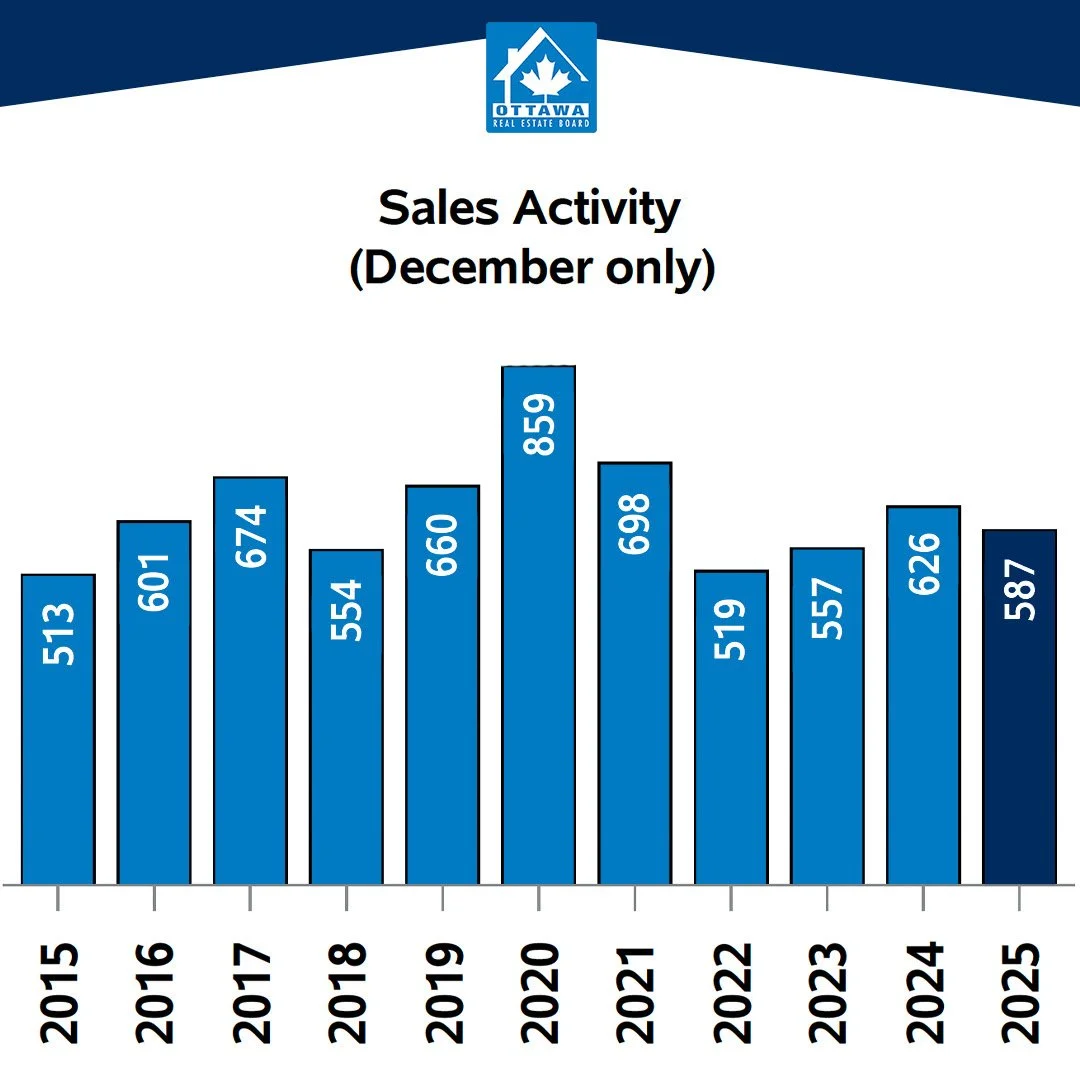
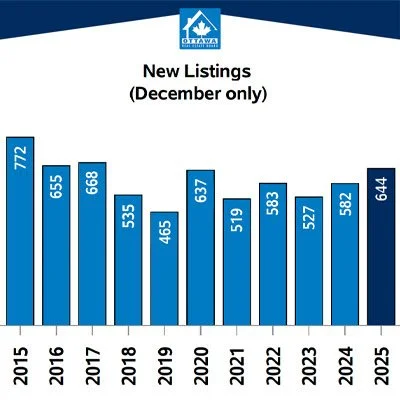
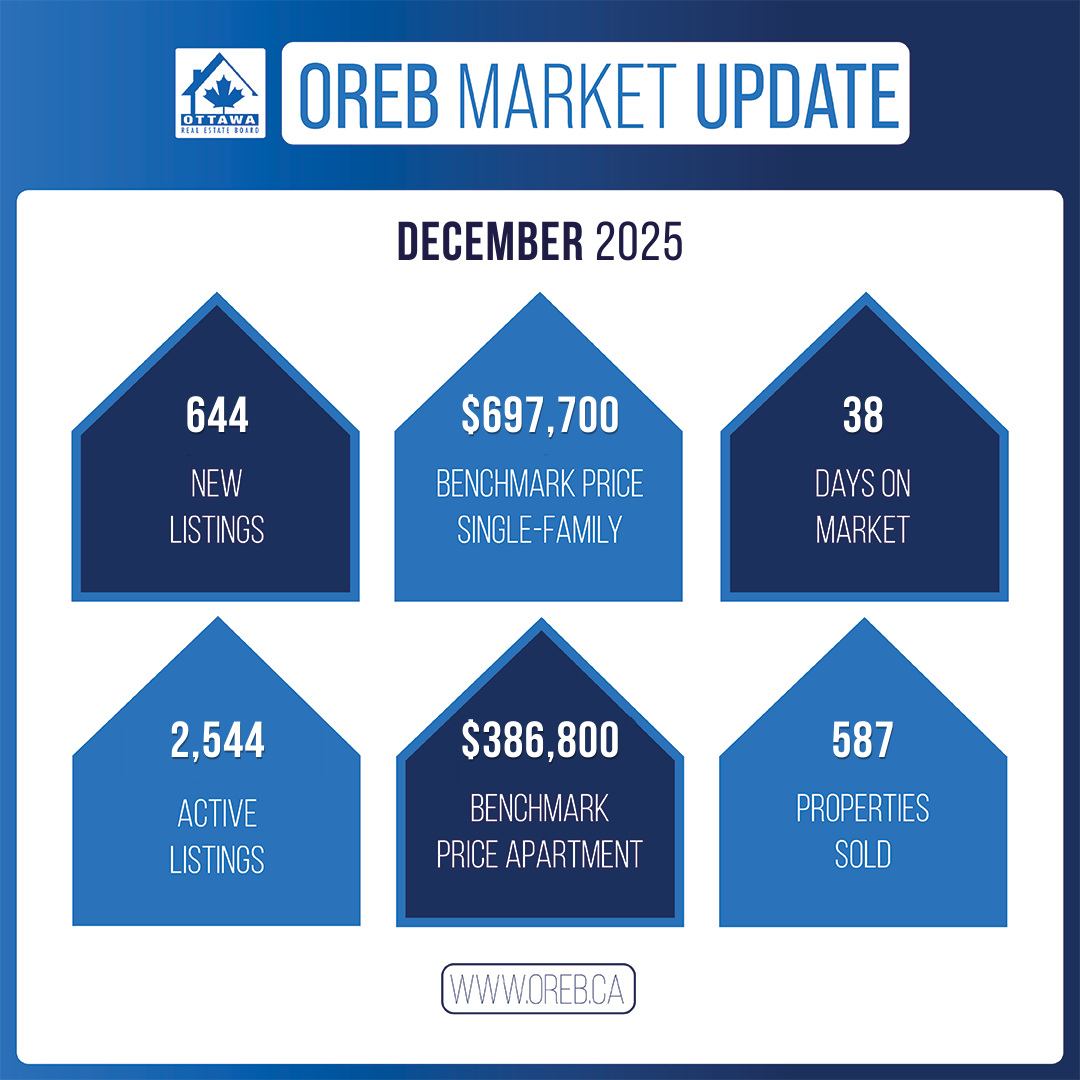
In December, 587 residential properties sold. That figure represents a 32 percent drop from November, but it aligns closely with long-term December norms when excluding the unusually active pandemic years. Since 2018, average December sales have hovered around this level.

The slowdown reflects both seasonality and ongoing buyer caution. Buyers are active, but deliberate.

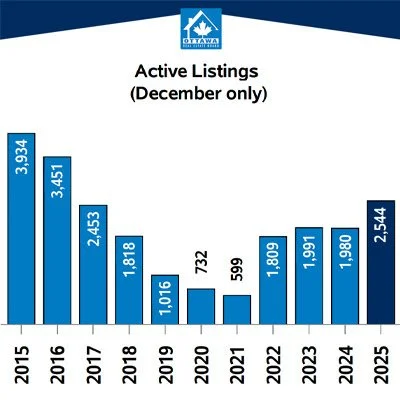
On the supply side, active listings declined from 3,628 in November to 2,544 in December, which is typical for the holiday period. Even so, inventory levels remain elevated compared with recent December benchmarks.

Looking at longer-term trends, Ottawa has been building toward higher year-end inventory levels since 2022. By December 2025, active listings were 19 percent higher than the same time last year, 45 percent higher than 2023, and nearly double 2022 levels. Months of inventory rose to 4.3, closer to pre-pandemic norms and firmly within balanced market territory.

Prices: Stable, Not Accelerating

Price movement in December reinforced the theme of stability.

The average residential sale price came in at $658,943, effectively unchanged from December 2024. This follows a modest year-over-year increase in November and suggests prices are being supported by demand, but not pushed upward aggressively.

The MLS Home Price Index adds nuance. Benchmark prices have edged down month over month since the summer, yet still finished 2025 slightly above 2024 overall. This tells a clear story: price adjustment is happening gradually and unevenly, influenced by property type and sales mix rather than broad market weakness.

Buyers today have more negotiating room than in recent years. Sellers, particularly in stronger segments, continue to benefit from resilient pricing.

How Different Property Types Performed

Market conditions varied significantly depending on the type of home.

Single-Family Homes
Detached homes remained the most stable segment in December. With 4.3 months of inventory, supply and demand stayed well balanced. The single-family benchmark price increased 0.4 percent year over year, underscoring the continued strength of this segment. Limited availability and consistent demand continue to make detached homes the backbone of Ottawa’s market.

Townhomes
Townhomes showed signs of adjustment as inventory stayed slightly elevated. The benchmark price declined 3.7 percent year over year, while the average sale price fell just 1.4 percent. That gap suggests benchmark-level softness rather than widespread discounting. Interest from first-time buyers continues to support transaction prices, keeping this segment relatively resilient despite increased choice.

Apartments and Condos
Condos remained the softest part of the market. Sales were subdued in December, and months of inventory climbed to nearly eight, well above balanced conditions. The benchmark price declined year over year, reflecting supply outpacing demand. While Ottawa has not experienced the same scale of condo oversupply seen in larger urban centres, this segment bears close watching heading into 2026.

Current months of inventory by segment:

  • Single-family homes: 4.3

  • Townhomes: 2.8

  • Apartments and condos: 7.9

What This Means Heading Into 2026

As the new year begins, the data suggests improvement in activity will likely be gradual rather than immediate. Interest rate relief has helped stabilize confidence, but buyers remain attentive to broader economic signals and affordability considerations.

For sellers, pricing accurately and understanding segment-specific conditions will matter more than ever. For buyers, increased inventory continues to offer choice and leverage, particularly in the condo market.

The broader message is consistent and clear. Ottawa’s housing market is stable, segmented, and increasingly shaped by fundamentals rather than urgency. Modest fluctuations are likely in 2026, but the underlying tone remains one of balance rather than volatility.

For anyone buying or selling in Ottawa this year, understanding how these conditions play out by property type and neighbourhood will be key.

Important to note is that these statistics can only be as accurate as there are condos sold in Ottawa. The more condos sold in an area, the more accurate the averages will be.

Want to chat about your options? Fill out the form at the bottom of the page, or text/call us directly at 613-900-5700 or fill out the form at the bottom of the page.

Do you have any questions about how this information affects your investment or looking for more information to make the best decision about your purchase? Let’s chat! Fill out the form on the bottom of the page.

Why Consistency Beats Talent in Ottawa Real Estate

Real estate tends to attract people who are looking for leverage. Flexible schedules. High earning potential. The ability to work for yourself. What often gets overlooked is that long-term success in this industry has far less to do with talent and far more to do with consistency.

After years of working in Ottawa real estate, one thing has become very clear. The agents who last and grow are not always the loudest, fastest, or most naturally gifted. They are the ones who show up repeatedly, follow process, and stay disciplined when conditions are not ideal.

That lesson matters more than ever in today’s market.

The Market No Longer Carries You

During high-volume years, the market covered a lot of mistakes. Leads were abundant. Buyers moved quickly. Sellers were forgiving. Even inconsistent effort could still produce results.

That is no longer the case.

Ottawa’s current market rewards agents who understand systems, timing, and execution. It punishes those who rely on momentum without structure. This shift has been uncomfortable for some, but it has also been clarifying.

When activity slows, habits matter. How often you follow up. How prepared you are for appointments. How well you understand neighbourhood-level data. How you communicate with clients when decisions are harder.

The agents who continue to grow are the ones who treat real estate like a discipline, not a reaction.

Consistency Is a Skill, Not a Personality Trait

Many people believe consistency is something you either have or you do not. In reality, it is trained.

Consistency comes from repeatable routines. Clear expectations. Accountability. It comes from doing the boring work even when no one is watching and results are not immediate.

In real estate, that often looks like:

  • Regular prospecting even when deals are closing

  • Ongoing education during quieter months

  • Reviewing performance metrics instead of avoiding them

  • Showing up to the office or team environments even when working solo feels easier

These actions are not glamorous, but they compound over time.

Structure Creates Freedom

One of the biggest misconceptions in real estate is that structure limits freedom. In practice, the opposite is true.

Agents with clear systems for lead management, marketing, client communication, and deal flow experience less stress and more control. They are able to step away when needed because their business does not rely on constant improvisation.

Structure allows agents to:

  • Respond to market changes faster

  • Serve clients more confidently

  • Scale without burnout

  • Build businesses that last beyond one good year

This is especially important in Ottawa, where neighbourhood dynamics, property types, and seasonal trends vary significantly.

The Role of Leadership and Environment

Individual discipline matters, but environment plays a critical role.

Agents perform better when expectations are clear, standards are consistent, and support systems exist. Teams and brokerages that focus on process, education, and accountability create conditions where agents can develop real skill rather than relying on short-term wins.

Strong leadership is not about pressure. It is about clarity. Clear goals. Clear feedback. Clear paths to improvement.

In challenging markets, leadership becomes even more important. Not to motivate through hype, but to reinforce fundamentals.

Long-Term Success Is Built Quietly

Most successful real estate careers do not have a single breakout moment. They are built through steady input over time.

The work compounds. The knowledge deepens. The confidence grows. Clients notice consistency long before they notice flash.

Ottawa’s market will continue to change. Rates will move. Inventory will rise and fall. Buyer behaviour will shift again. The agents who remain steady through those cycles are the ones who understand that consistency is not a fallback. It is the strategy.

If there is one lesson worth internalizing in real estate, it is this: talent opens doors, but consistency keeps them open.

Ottawa Real Estate in 2026: Why Experience Matters More Than Ever

The Ottawa real estate market is no longer driven by urgency. The days of writing blind offers, skipping due diligence, and making decisions under extreme pressure have largely passed. What has replaced them is something quieter and more complex.

Today’s market rewards judgment.

For buyers and sellers alike, success now depends less on speed and more on understanding. Understanding neighbourhood-level pricing. Understanding timing. Understanding how to structure decisions that hold up not just on closing day, but years later.

This shift has changed the role of a real estate agent in a meaningful way.

A Market That Requires Interpretation, Not Just Data

Ottawa remains a fundamentally stable market. It is supported by government employment, healthcare, education, and a steady inflow of people relocating for work and lifestyle reasons. That foundation has not changed.

What has changed is the margin for error.

With more listings on the market and buyers taking their time, pricing needs to be precise. Overpricing no longer gets corrected by competition. It gets ignored. Under-preparing a home does not create urgency. It creates doubt.

Market stats alone do not tell that story. Interpretation does.

This is where experience matters most. Knowing how similar homes are actually performing, not just what they are listed for. Knowing which neighbourhoods remain competitive and which ones require a different approach. Knowing how buyers are reacting in real time, not months later in a report.

Buyers Have Leverage, But Only If They Use It Well

Buyers today have more choice and more time. That is an advantage, but it can also be a trap.

More options often lead to hesitation. Longer decision windows can create second-guessing. Without a clear strategy, buyers risk missing good opportunities while waiting for perfect ones that may never come.

The strongest buyers right now are prepared. They understand their finances clearly. They know which compromises they are willing to make. They are not trying to time the bottom of the market. They are focused on buying well.

That kind of clarity rarely comes from scrolling listings. It comes from good conversations and honest advice.

Sellers Need Precision, Not Optimism

Selling in today’s market requires a different mindset than it did a few years ago.

Optimism alone is not a pricing strategy. Neither is hoping the right buyer will eventually show up.

Homes that sell well in Ottawa right now tend to share a few things in common:

• Accurate pricing based on recent, comparable sales
• Thoughtful preparation that reduces uncertainty for buyers
• A clear marketing plan that creates confidence, not noise

When those elements are in place, homes still sell. Often quickly. When they are not, listings stagnate and price reductions follow.

The difference is rarely the market itself. It is the strategy going in.

Real Estate Is Still a Long-Term Decision

One of the biggest risks in any market is short-term thinking.

Buying or selling real estate is rarely just about the next six months. It is about how a decision fits into someone’s life over the next five, ten, or twenty years.

This is why context matters. A slightly higher price can make sense if it secures the right location. Waiting for a perfect rate environment can cost more than it saves. Selling earlier than planned can be the right move if it aligns with a broader life change.

These decisions are not made well in isolation. They require perspective.

What Clients Actually Need From an Agent Right Now

The role of a real estate agent has evolved.

Clients do not need someone to push them into action. They need someone who can help them think clearly.

That means asking better questions, not just providing answers. It means being honest when waiting makes more sense than moving. It means understanding that not every transaction needs to happen right now.

In a market like this, trust is built through restraint as much as action.

Looking Ahead to 2026

Ottawa’s real estate market heading into 2026 is balanced, nuanced, and highly local. Broad headlines matter less than street-level knowledge. Strategy matters more than speed.

For buyers and sellers who value clarity, preparation, and long-term thinking, this market offers real opportunity.

The key is working with someone who understands not just where the market has been, but how it is behaving now.

If you are considering a move in the coming year and want a grounded, honest perspective on your options, the conversation should start there.

Why Some Homes Sit on the Market in Ottawa (Even When the Market Is “Good”)

When a home sits on the market longer than expected, the first assumption people make is that something must be wrong with the market.

In reality, we regularly see homes struggle even during balanced or active conditions. At the same time, nearly identical properties nearby sell quickly and cleanly.

The difference usually has nothing to do with timing and everything to do with strategy.

Price Is Not the Only Reason Homes Don’t Sell

Pricing matters, but it is rarely the only factor.

Many listings fail because they are priced correctly on paper but positioned poorly in real life. Buyers do not shop spreadsheets. They shop emotionally first and logically second.

When a home feels overpriced compared to nearby alternatives, even by a small margin, buyers hesitate. That hesitation often leads to fewer showings, which then reinforces the perception that something is wrong.

Once that perception sets in, price reductions become less effective than sellers expect.

Presentation Drives Buyer Confidence

In Ottawa, buyers are comparison shopping more than ever. Online photos, videos, and listing descriptions are often the first showing.

Homes that lack strong photography, clear layout explanations, or accurate descriptions force buyers to fill in the gaps themselves. Most will not bother. They simply move on to the next listing.

This is especially true in competitive neighbourhoods where buyers have multiple options within the same price range.

A well-presented home does not just look better. It feels safer to buy.

Listing Timing Is About Competition, Not Seasons

Many sellers focus on the time of year. Far fewer think about who else they are competing with at the moment they list.

Launching when several similar homes hit the market at the same time can dilute attention quickly. Buyers may tour them all, but they rarely feel urgency for any one option.

Homes that sell well are often the ones that enter the market when inventory is thinner or when their specific home type is underrepresented.

Overexposing a Listing Can Hurt More Than Help

Long days on market change how buyers interpret value.

Once a listing becomes familiar, it loses urgency. Buyers assume it will still be there later, which delays decisions and weakens negotiation leverage.

In some cases, a listing becomes “invisible” even though it is still active. New buyers entering the market focus on what feels fresh, not what has been sitting.

This is why the first few weeks of a listing matter more than most sellers realize.

What Successful Listings Have in Common

Homes that sell efficiently tend to share the same fundamentals:

  • A price that matches buyer perception, not just recent sales

  • Strong marketing that explains the home clearly and honestly

  • A launch strategy that limits competition and builds momentum

  • Clear expectations set with the seller before going live

None of these rely on luck or market timing. They rely on preparation and strategy.

Selling Is About Controlling the Variables You Can

The market sets the backdrop, but sellers control far more than they think.

When a listing struggles, it is usually because one or more controllable factors were overlooked early. Fixing those issues later is possible, but it is always harder than getting it right from the start.

This is why we focus on strategy well before a home hits the market, not after feedback starts coming in.

If you are thinking about selling and want to understand how buyers will actually perceive your home, that conversation should happen before a sign goes up.

Ottawa Condo Market Outlook for 2026: What the End of 2025 Is Telling Us

As 2025 closes, Ottawa’s condo market is settling into a more stable rhythm shaped by increased inventory, cautious optimism from buyers, and the early effects of repeated interest rate cuts. The final quarter of the year has been notably different from the fast, supply-tight conditions that defined much of the previous market cycle. For many buyers and sellers, this shift has created a clearer and more predictable landscape heading into 2026.

Our team has spent the past year tracking building-level trends across Centretown, Westboro, Hintonburg, the ByWard Market, and surrounding urban neighbourhoods. Here is what the data and day-to-day activity are showing as we move into the new year.

More Supply Means More Strategy

Condo inventory remains higher than last year, giving buyers more space to compare units, evaluate buildings, and make decisions without pressure. Sellers are adjusting to a market where presentation, pricing accuracy, and building reputation carry more influence on final sale outcomes.

Well-maintained units in desirable buildings continue to move, while listings that enter the market without preparation tend to sit longer and require adjustments. The advantage now goes to the seller who invests in strong marketing and understands their building’s competitive position.

Interest Rate Cuts Have Laid the Groundwork for 2026 Activity

Rate cuts throughout 2025 gave buyers some long-awaited breathing room. While affordability challenges have not disappeared, the reduction in borrowing costs has encouraged more pre-approvals, more showings, and more long-term planning.

We expect early 2026 to bring increased buyer participation, particularly among first-time buyers who spent much of 2023 and 2024 in wait-and-see mode. Investors are also re-entering specific buildings with strong rental track records and stable condo management.

Downtown Continues to Present Value

Despite renewed interest in urban living, downtown condo prices remain competitive relative to other major Canadian cities. For buyers who prioritize walkability, transit, and access to employment, the core is still one of the most cost-effective entry points into ownership.

Buildings with reliable reserve funds, consistent fees, and efficient layouts are seeing the strongest demand. We expect this trend to continue into 2026 as more buyers seek neighbourhood convenience paired with attainable price points.

Buyers Are Focusing on Practicality

In a market with more selection, buyers are prioritizing:

• functional layouts
• natural light and exposure
• in-unit laundry
• parking
• strong condo management
• predictable fees
• buildings with a track record of stable resale activity

A unit that checks these boxes stands out quickly. For sellers planning to list in early 2026, highlighting practical value is proving just as important as showcasing design.

Sellers Need a Building-Specific Plan

Sellers who succeed in this market approach their listing with a clear strategy. That includes understanding recent comparable sales within the building, identifying unique selling features, choosing the right timing, and preparing the unit carefully.

Professional marketing, accurate pricing, and storytelling around the lifestyle of the neighbourhood continue to play a major role in attracting qualified buyers.

Heading Into 2026

Ottawa is closing 2025 with a market that is neither overheated nor stalled. It is balanced, selection-rich, and increasingly influenced by thoughtful consumer behaviour. As conditions continue to stabilize, both buyers and sellers have strong opportunities to make confident moves.

If you are considering a purchase, sale, or investment in the condo market as we approach 2026, our team studies these buildings daily and can help you understand the factors that will matter most in the new year.